
Salvation Mountain
(n.) A brightly painted monument crafted by Leonard Knight. The sculpture honors love and faith and is located several miles away from California’s Salton Sea, a former resort destination destroyed by contamination from agricultural runoff and toxic dust.
I.
God is love on the Salton Sea.
I bathe with belly-up birds, pulse a heartbeat
through their rotten eggshells bloating in the
blue, bat my pruned hands at a smoke haze of brine flies,
& think about that one time Sasha took me
to church in the second grade. I wore
my dirty hair in pigtails. A white dress
stained with canola oil & the runny red at the
end of a ketchup packet. Sasha sang hymns &
I watched her lips part. Her mother only
let her wear lipstick on Sundays. Coral Crush or
Pinky Promise on her cold bathroom counter. She had
a headache on the drive home so I held the pieces of
her body until she fell asleep. Say I’m a sinner. Come into
my heart. There’s lithium in the water & I’m meeting the same
fate as the fish & receding tide as the sun bends down to drink.
II.
In the 60s, Sinatra reeled in a tilapia
from his speedboat while his daughters molded factories
of sand on the shore. I imagine them swimming.
Now the salinity turns my skin to scab & flake. Yellow algae
blooms between all my toes. You might
call it an environmental crisis. I call it 21st century
adolescence. I croon along to the lone gull
twitching her half-snapped wings in the sky. Fly me to the moon.
I like ghost towns because the dead tell the best stories &
the creaking marina hums the best songs, rotten wood
planks soft & slick as a shot snake’s underbelly.
We all sit at a bar, watch big boys play baseball with
twigs licked to ash by last summer’s long-haired flame.
At night, I beg: Let me play among the stars.
III.
Love is universal. I sit among painted
flowers & ask God how we’ve come to this.
I miss believing in seas that don’t scar my lungs,
picking beach roses out of brambles, & everything else I’m told.
Last I heard, Sasha was going to school in Paris.
I wonder when she learned French. I’m waiting for her
to pull up with an ice-cool soda & the top one hundred hits
on the radio but it’s just one hundred degrees & instead of
tanning, I only burn. We’re animal skeletons. The water
still gets more chemical & the dead birds still die
all over again like a bad
movie I can’t turn off: their feathers
crusted in crumbs of salt, ripped from skin for another season.
I’m past saving myself. If God is love, I want
to see what he’s really doing.
Sierra Elman
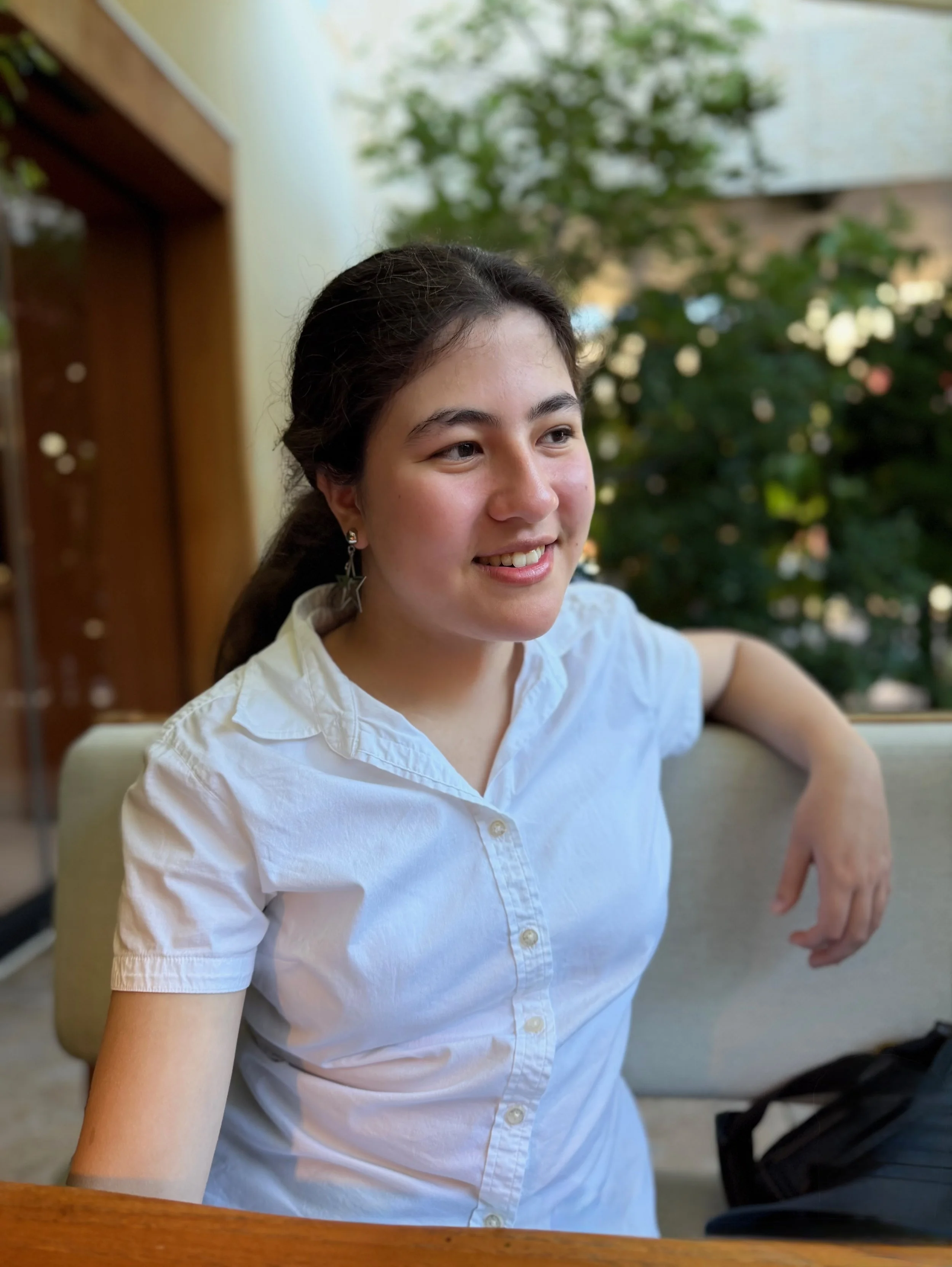
Sierra Elman is the 2024-2025 Youth Poet Laureate of Burlingame-Hillsborough. She has been recognized by the The Adroit Journal, the Alliance for Young Artists & Writers, DePaul's Blue Book: Best American High School Writing, and many others. Sierra is also the co-founder and editor-in-chief of Marmalade Lit and is an alumna of the Adroit Journal's Summer Mentorship Program and the Kenyon Review’s Young Writers Workshop. Aside from writing, she can be found listening to boygenius or trying to get her dog to come when called.
Why this Knocked Taylor Out:
Really after I read the first section I was locked in. It takes a great ecopoet to balance both the thingyness of humans and the ethereal crush of nature and its current predicaments. I think the sound work here is doing so much work to create an almost slimy rhythmic feeling and I think the images are just punching exactly how they should. The interview below gets into much better detail about the sound work so that is definitely worth reading.
I have a whole essay in my back catalogue about the spiritual nature of eco poetry and the difference (or lack of) the difference between spiritual poetry and ecopoetry and I think this poem is also really centered in that idea of both God as God but nature as God or also leaves space for mankind to blur the lines there.
And of course the overall structure of the poem really lends itself well to that.
Interview:
Why did you choose Team Taylor for this poem?
I submitted to Team Taylor because I felt that my piece "Salvation Mountain" seemed to embody aspects of what she was interested in (religious iconography, ecopoetics, the human body, etc.)! I discovered BRAWL when I was looking for a home for this piece and it's now become one of my favorite magazines to peruse. I also love the model that lets writers submit to an editor they believe is fit for their work!
When I think of the triptych form, I always associate it with religious poetry/iconography. This poem is clearly drawing on those themes as well within its imagistic choices. How does faith/nonfaith work its way through your work, and in this poem in particular how were you thinking about drawing connections between g(G)od and the natural world?
In my writing, I often find myself exploring how faith (or loss of faith) plays into an ailing world—what does it mean to believe when a society or environment feels like it’s crumbling? In "Salvation Mountain," I specifically wanted to tackle a narrator with an already-strained relationship with religion grappling with a site of environmental destruction. I wanted the spiritual questions haunting her to rise to the surface when faced with the Salton Sea, a location marked by severe decay, and Salvation Mountain, an art piece nearby honoring love and faith—two very different symbols.
Sound work seems to be a central focus of your poetry, in this poem and in the others I read from you. How do you operate within prosody and what comes first, the sound or the images in your work?
When it comes to my writing, the creation of images and sound often flow into one another. For this poem in particular, I knew musicality was important—music is threaded through all three stanzas (hymns in the first, Sinatra in the second, and contemporary pop music in the third) so I wanted to create a sonic world that subtly amplified that. In addition, I wanted the deteriorating environment to serve as a sort of character as well, prompting the narrator to question her understanding of religion—so I tried to give it a "voice" through repeated sounds.