
A Prodigal Son
& so desperately unfathered,
they said, he threw himself into
the hot tub of a hotel room he couldn’t afford.
He might’ve imagined himself
drowning there, in amniotic fluid, lost
boy solution, accompanied by a top shelf
liquor on the generosity of Capital One.
He launched himself, no goal in mind, imprecise:
propelled by a fantasy of being a son.
Not necessarily even a prodigal one:
but alas, rock & roll’s smarmy seraphim
took him—it could have been anyone.
Locking eyes with the frontman,
he offered a Jägermeister shot from
each boot, and was led by a God-seeming hand
very far indeed from the promised land.
Thank the Lord it was him, not us,
ravaged by a rock & roll band.
Luke Horsey is a queer poet based in Glasgow, Scotland. His creative practice is conditioned by linguistics, music and psychoanalysis. His writing has been featured by the Dead Cat Poetry Prize, TPW Poetry Prize, & Change and Poetries in English, among others.
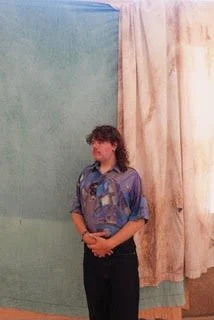
Interview:
1.) What do you consider the driving force behind your poems? The "engine" if you will, that keeps each one running? is it always different? If so, what fuels the engine of this poem?
I recently was at a workshop with Raymond Antrobus where he spoke about D/deaf identity as both a “condition” and a “poetic”. I’m going to appropriate that discussion a little bit by telling you that the engine driving my poetry is my queerness. I love this polysemy of “condition” because it doesn’t just refer to a characteristic or diagnosis – it’s actually a state of being in the world, like an alternative way of metabolising information.
Queer people have a fascinating relationship to the making of meaning because their first years on Earth are spent painfully discovering they exist in direct contradiction to the scripts of interaction and relationships they are readily exposed to. In this way, when I write from my queerness, I am using my “condition” to break apart scripts; and I am destroying everything my reader knows about what is signifying and what is signified.
2.) What is your drafting process like? Voice notes, phone memos, type writer, napkin notes? I'd love to know the tea!
I’m interested in collecting fragments of what oozes from the unconscious. Piecing together these fragments is often how my drafting process begins. I’ve always been an insomniac, and there was once a time in my life when I was taking the maximum dose of melatonin to get myself to sleep each night. I realised how much incredible access to the unconscious my melatonin dreams were giving me, and I started to sleep with a notebook under my pillow to frantically write them all down whenever I’d wake up.
I don’t take so much melatonin anymore, because I’m back living in the UK where it’s hard to get hold of. However, I still collect a lot of unconscious dribbling in my notebook whenever I’m on the edge of lucidity. That may well be when something is keeping me up, when I’m hungover, or when I’m in that weird half-asleep, half-awake state you sometimes reach when you’re trying to sleep on a flight. Then, later at my desk, I begin putting all the little psycho-babble-blocks together like Lego.
3.) What have you read, watched, or listened to lately that you feel is feeding your work right now?
I’ve just finished Catherine Liu’s new book Traumatized: The New Politics of Public Suffering. I am incredibly interested in the language of lived experience and trauma, and the fetish for public confession that contemporary society has developed. When I got to see Liu speak in London last month in support of the new book, one of the audience members asked her a question along the lines of, “But isn’t trauma often the beginning of great art?” To this, she replied that the fact of using trauma for content is not what has constructed so many of these great stories – it is the craft of good storytelling itself that wraps itself around these lived experiences.
This answer took me back to earlier this year when I was writing “A Prodigal Son”, where I was really thinking about locating my lived experience outside of myself and exploring the story of an experience I’d had through the call-to-adventure phase of Joseph Campbell’s ‘The Hero’s Journey’ framework. If we, as writers, want to explore our trauma as a theme, I think that is great. However, I wonder if this should be more a practice of exploring it through storytelling as a meticulous and ancient craft, rather than simply throwing it on the table.