
Part of the Flock
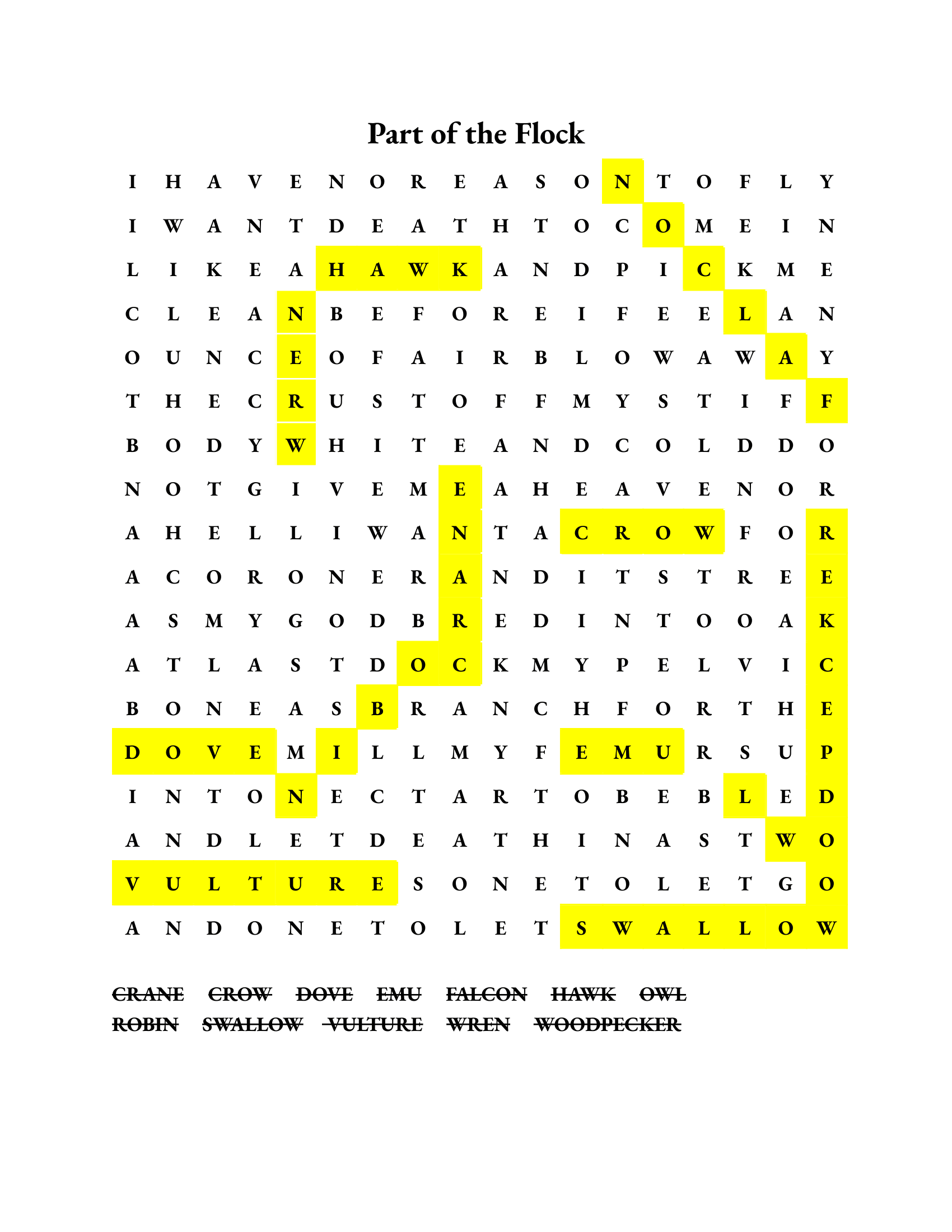
(plain text)
I have no reason to fly
I want death to come in
like a hawk and pick me
clean, before I feel an
ounce of air blow away
the crust off my stiff
body, white and cold. Do
not give me a heaven or
a hell, I want a crow for
a coroner and its tree
as my god, bred into oak.
At last, dock my pelvic
bone as branch for the
dove; mill my femurs up
into nectar to be bled,
and let death in as two
vultures: one to let go
and one to let swallow.
Steven C. Wright
Steven C. Wright (he/him) is a queer poet and prose author from Edison, New Jersey. He has a B.A. in English from Rutgers University-New Brunswick, and runs a small poetry workshop group every week. His work has appeared in Frontier Poetry, Serotonin Press, Full House Literary, Burial Magazine, and elsewhere.
Why this Knocked Taylor Out:
THE FORM! SO COOL! But guess what, the language, ALSO SO COOL. I love everything about this. I love how interesting it is, I love the images and use of birds and turns of phrases. I love when poets show off how smart they are! "Do not give me a heaven or a hell, I want a crow for a coroner," is such a stunning line I wish I wrote it. And there's a really interesting tension between the kind of animalistic and intense language and the overly structured form. I don’t even know that I have anything smart to say about this poem because I am so just freaking stoked about it. Getting to play with language like this is what poetry is all about baby!!!! Inject it into my veins!!!!!!!
Why did you choose Team Taylor for this poem?
I've submitted to BRAWL several times, and I end up taking a lot of careful consideration with submissions to y'all to properly choose my reader. This piece I had in line to submit to either of you! The crux of this piece, though, concerns itself with a lot of body/animalistic images, a lot of guttural feeling. The suppositions on the afterlife, on "returning to the Earth," as it were. These were all things that pointed this poem towards Team Taylor for me. Plus I know both of you are partial to experimental forms, so I was just plainly excited to send this piece to this publication at all.
The form for this is obviously incredible and cool, but the language itself is just as compelling to me. Which came first, the form or the language, and how did you work to make those two things function together?
The form came first! This poem began as I was workshopping ideas for Frontier Poetry's "Hermit Crab Challenge" that opened in 2024, where I remembered an old attempt I had at making a poem that doubled as a word search. It never really took shape the way I wanted it to, and this one wasn't giving either until I sat with myself and fully justified the form in my head. Why is it a word search (or "Bird Search," as was the original title)? It was then that I got the first line. I wanted the poem to juxtapose death and the afterlife with a sort of earthly humdrum. The idea of dying a boring death: "becoming a husk" and nothing else. That way the poem could be "buried" amongst the names of birds; some of which take shape inside the piece itself. Almost like the birds are "above" the words, like circling vultures. It was a lot of fun to see it visually like that, and it informed a lot of the language choices. But it was also a real concentrated effort to make everything line up the way that it did.
How does this poem fit within your usual discography?
Hardly!! It's a special one, and writing it was so unlike my usual process. Funny enough, just comparing it to my Team Martheaus piece from 2024, it's complete tonal and formal whiplash. The throughline between this piece and a lot of my work is in the existentialism and internalized subjects, the focus on the self; but I like writing poetry that has a much bouncier, flowy tone. I'm always thinking about poems sonically: where to break my lines, the rhythym of it, the hows and whys, and with this poem I had a strict amount of characters to use per line. I had to give myself so many more rules than I ever do just to make it all stand up, and because of it the voice of this poem, of the speaker, is a lot more focused and clinical.